
Region Selection for Miners: Latency, Power and Legal Reality
Where a miner plugs in decides more than the electricity rate. At today's difficulty of 132.76 T, a 500 TH/s setup earns about $19.00 of gross BTC per day, and at 30 J/TH it burns roughly 360 kWh daily — about $21.60 at $0.06/kWh. A hosting decision that looks like a power question is really a power, latency and paperwork question at once.
Key takeaways
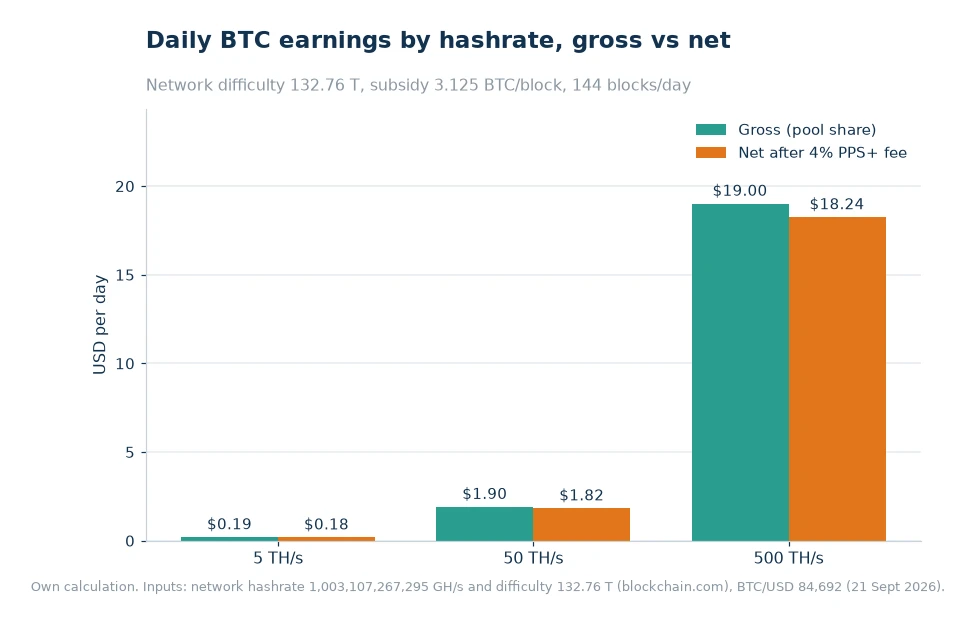
- At 132.76 T, a 500 TH/s rig returns $18.24/day net of the listed 4% PPS+ block-reward fee, against $19.00 gross — so a power cost above ~$18/day consumes the whole margin.
- Joules per terahash, not contract length, sets your power bill: 500 TH/s at 20 J/TH is 10 kW, at 30 J/TH it is 15 kW, and only one of those clears a $0.06/kWh bill at today's difficulty.
- Settlement mechanics set how fast a region turns hashrate into cash: PPS+ pays hourly at current difficulty, PPLNS distributes after 6 confirmations using a 5-difficulty-round window.
- Two questions decide most moves — what the listed fee applies to (4% on the block-reward component, 2% on transaction fees), and how many kilometres of network sit between the machine and the pool's entry node.
Why the numbers move
Regional promises sound similar because they are written by the same kind of sales page: cheap power, available racks, no questions. What differs is the arithmetic underneath. Three inputs move your daily revenue, and none of them are about the building.
The first is network hashrate. Bitcoin targets a ten-minute block time, so block rewards get harder to earn whenever total hashrate climbs, and cheaper to earn when it falls. The second is your machine's efficiency in joules per terahash, because it multiplies every kilowatt-hour you buy into hashrate. The third is the fee structure of the pool you point at — not the headline rate, but what each component of that rate applies to.
Everything else a region offers is a constraint on those three. Power is the largest one, and it is the easiest to compare badly, because contracts quote rates that exclude cooling, transmission, transformers, demand charges and the load factor you are actually allowed to run.
What changes your payout
A stable, verifiable mining income starts with settlement rules rather than with geography. ViaBTC publishes two payment methods, and the difference matters when you model a site.[1]
| Variable | How you measure it | Where it costs you |
|---|---|---|
| Pool latency | Stale-share rate and ping to the pool entry node from the rack itself | Every rejected share is hashrate you paid for and never got credited |
| Effective power price | Metered kWh per rack, not the contract headline rate | A 500 TH/s rig at 30 J/TH draws 360 kWh/day, so each extra cent per kWh costs about $3.60/day |
| Cooling load | Ambient temperature range through the year, and whether cooling is inside the quoted rate | Hot-season derating or fan power shows up in joules per terahash, not on the invoice |
| Settlement rail | Whether earnings leave the pool account immediately or wait on a threshold | Hours of exposure versus weeks, plus the spread on any off-ramp |
| Legal and compliance | Local rules on importing hardware, converting mined coins and hosting third-party machines | A forced relocation costs a full rig's worth of downtime in freight and reinstalling |
Then there is the payout side, which most site comparisons skip. PPS+ settles the block-reward component per share with a listed 4% fee and pays out every hour against current difficulty, while the transaction-fee component follows PPLNS logic at a listed 2%. Pure PPLNS combines both components with a listed 2% fee and distributes after the block reaches six confirmations, weighted by each miner's share of pool hashrate over the last five difficulty rounds.[2]
Read those two sentences as a cash-flow map. If your hosting contract and your electricity contract are both invoiced monthly, a payout method that settles hourly means the mining revenue arrives before the bills do. If your rent is paid quarterly in advance, the same choice means you are advancing cash for a quarter to collect it in hours.
Worked example
Take a single 500 TH/s rig. Against a network hashrate of about 1,003 EH/s and 450 BTC mined per day across the network, 500 TH/s earns 0.00022430 BTC per day. At $84,692 per BTC that is $19.00 gross, and $18.24 after the listed 4% fee on the PPS-settled block-reward component.
Now hold earnings fixed and move the efficiency figure, which is what a different region differentiates on. At 20 J/TH the rig draws 10 kW, or 240 kWh per day: $14.40 at $0.06/kWh, leaving $3.84 a day. At 30 J/TH it draws 15 kW, or 360 kWh per day: $21.60 at the same rate, which is above the $19.00 it earns. Same hardware, same region, same coin — one of those setups pays its power bill and the other does not.
Scale that comparison to a site rather than a machine and the region question answers itself. The same efficiency spread decides whether a hall is profitable, and it decides it before rent, freight or staff enter the calculation. Running the numbers first is faster than moving hardware: a profit calculator that accepts coin price, difficulty, fee rate and measured valid hashrate will show whether a quoted power price leaves any margin at your rig's real efficiency.
What to check monthly
Site economics drift, so the review that matters is the recurring one. Four checks, in this order, take about twenty minutes.
- Metered consumption against modelled consumption. If a 500 TH/s rig at 20 J/TH should draw 240 kWh a day and the meter says 275, cooling, fan curves or a hot aisle are eating the difference. That gap is the most common hidden cost on a site.
- Valid versus nominal hashrate. A pool-side mining pool dashboard shows per-worker output, so a machine reporting 500 TH/s locally while contributing 460 TH/s to the pool is a real, monthly, recurring loss — usually latency, firmware or a failing hashboard.
- Difficulty trend. Difficulty moves with the network, not with your region: at 132.76 T the network produces 450 BTC a day, about $38.1 million, and that pool of revenue is shared by everyone. A rising difficulty line means the same hardware earns less next month at the same power price.
- The exit cost. Read the notice period in your hosting contract and the local rules on moving machines and coins out. The cheapest region on paper is expensive if leaving it takes a quarter and a customs dispute.
Where the pool side of the decision sits
Region and pool are separate choices, and conflating them hides where the money goes. A pool does not mine for you; it collects shares, proves the work to the network and splits rewards in proportion to contributed hashrate. What a region adds is latency and a power price, and what a pool adds is a fee schedule, a settlement cadence and a payout rail.
That is why the practical test is to hold the pool constant while comparing sites. Point both candidate regions at the same pool, run the same hardware for the same period, and compare credited hashrate per metered kilowatt-hour rather than contract rates per kilowatt-hour. Features such as global node deployment and hourly settlement matter here for a structural reason: they shorten the distance between a hash computed in a rented hall and a balance in your account, and they remove the orphaned-block risk that a miner in a high-latency region absorbs disproportionately.[3] For miners weighing a hosted site against a self-built one, a ViaBTC Mining Pool account is useful precisely as the constant in that comparison: the same dashboard, the same fee components and the same settlement metrics across every region you test.
Frequently asked questions
What happens if my miner goes offline?
Shares stop, so expected income stops with them. Alerts and a dashboard that shows per-worker hashrate shorten the gap between a failure and a fix.
Is a bigger pool always better?
Size reduces payout variance but also concentrates hashrate. What matters more is fee structure, uptime, latency and payout cadence.
Which single regional number should I compare first?
Metered kilowatt-hours per terahash per day, which combines the power price you actually pay with the efficiency the site's climate forces on your hardware. Everything else is a distant second.
Does hosting location affect the fee I pay?
No — the listed pool fees are a property of the payment method, not of the rack. What location changes is how much of your gross hashrate reaches the pool as valid shares, and what your power bill takes out afterwards.
Do this before you sign
Ask for metered consumption per rack, a stale-share rate and the effective kWh price including cooling. Then model one machine at its real joules per terahash against current difficulty and see whether any margin survives the power bill. If the answer is yes on paper and yes on the meter for a month, the region is a business decision rather than a bet. Repeat the check monthly, because 132.76 T today is not 132.76 T next quarter.
Data and sources: ViaBTC pricing and fee documentation[1][2], network difficulty and hashrate from public chain data, hosting and farm information published by the pool[3]. Figures use a network hashrate of 1,003,107,267,295 GH/s, 450 BTC mined per day and a BTC price of $84,692, all read on 21 September 2026; they are illustrative and move with difficulty and price.